At a glance
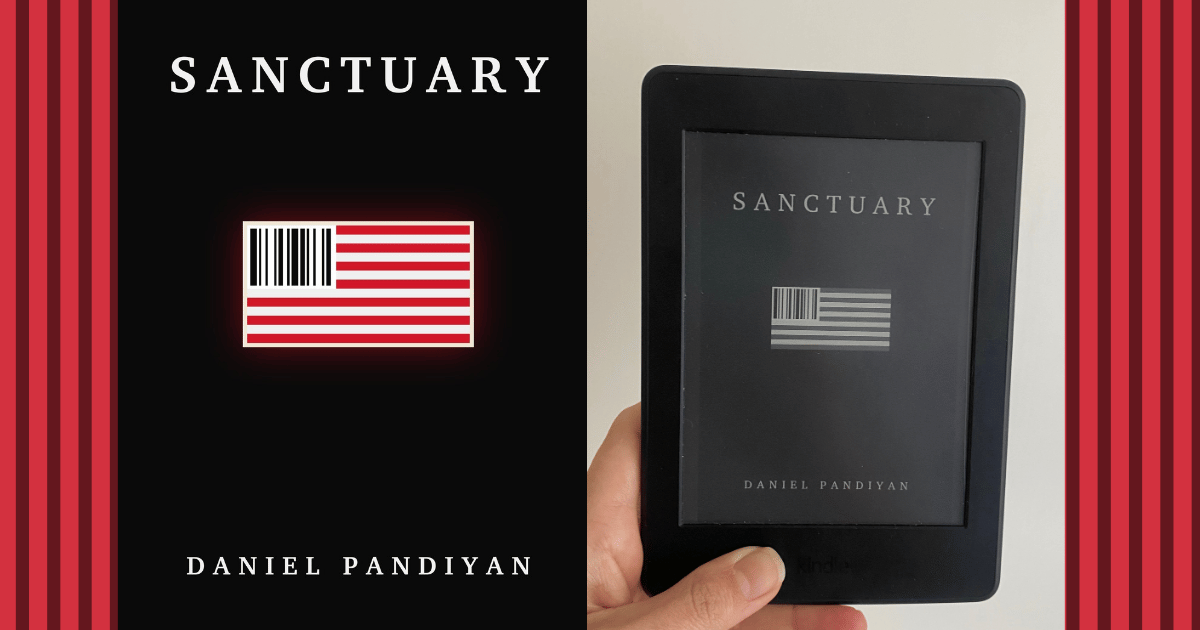
Sanctuary
Daniel Pandiyan


| Genre | Literary fiction / dystopian |
| Format | eBook (Kindle), 304 pages |
| Source | ARC (advance review copy) I received a free copy of this book in exchange for an honest review. |
| POV | Third person |
| Tense | Present |
| Did I finish it? | Yes, in 6 days |
| My rating | 4 / 5 |
| Read if you liked | The dystopian road-walk urgency of Parable of the Sower, the indentured labour rage of The Grapes of Wrath, and the migrant border crossing dread of American Dirt. |
| Would I recommend it? | ✓ Yes |
Advance Review Copy
I received an advance review copy of this book from the author in exchange for an honest review. All opinions are my own. Sanctuary is scheduled for release on 12 November 2026.
Miles Jensen is a boy living in a Costa Rican orphanage when a solar flare ends the world as he knows it. With the orphanage no longer able to feed its children, Miles makes a choice before the choice is made for him: he leaves, taking two friends with him, and heads north. His grandparents are somewhere in Wisconsin. That’s all he has.
Synopsis
Note: this has some gentle spoilers.
Set in the aftermath of a catastrophic solar storm that has destroyed global infrastructure, Sanctuary follows Miles and his small group as they travel roughly 3,000 miles on foot from Central America toward the United States. The journey is brutal: blistered feet, starvation, dehydration, cartel violence, and the constant threat of desperate people doing desperate things. But when they finally near the US border, the story pivots into something darker and more insidious: a government worker program that has been quietly hollowed out by exploitation, trapping migrants in a modern form of indentured servitude from which there is no legal escape.
My review
Daniel Pandiyan is a debut novelist and painter based in Chicago, and Sanctuary reads like the work of someone who has thought long and hard about the stories that don’t make the news. In a post on his website, Made in Los Angeles, Pandiyan confirms that the gangs in this book (MS-13 and Barrio 18) are real, and that his depiction draws on research including travel through Honduras. The Central American sections of this book do not feel like set dressing; they read like the writer has walked through them himself. Immersive.
The novel’s first half strongly reminded me of Parable of the Sower; not in tone, but in structure and premise. A society that has crumbled. A protagonist who must leave. A dangerous world to walk through. Like Octavia Butler, Pandiyan uses the road as a moral testing ground: who helps, who harms, who turns away.
The second half is where the book becomes something else entirely. The pivot to indentured labour: migrants drawn in by a government worker program only to find themselves perpetually indebted to the farms and businesses they work for, unable to leave, unable to repay. It’s the novel’s sharpest argument.
This is The Grapes of Wrath territory: systemic exploitation dressed up as opportunity. When Miles’ friend (a girl) is absorbed into one of these operations, he and another friend attempt to find her, running headlong into bureaucracy and the closed doors of “confidential information.” It’s infuriating. And real.
I asked Pandiyan some questions for this review, and when asked what question he’d want book clubs to discuss, he said privilege; specifically the kind we can’t see in ourselves. He describes the novel as asking: “Who would you be, and what would you be worth, if you were stripped of the privilege you never chose and never noticed?”
What I liked/What I didn’t
What I liked
The pacing. And the pivot in the second half. The long walk was starting to lose my interest, but the indentured labour plotline wrenched me back and hooked me. Miles is a well-drawn protagonist: young enough to be credible in his naivety, but resourceful enough to carry the story.
What I didn’t
At 304 pages, it doesn’t overstay its welcome, but there were moments in the middle section of the journey where the episodic structure felt slightly repetitive – one village, one danger, move on. As I said, it then pivots and breaks this up.
Final verdict
Sanctuary is a road novel, a social novel, and a comment on immigration and the migrant economy, as well as what we can allow ourselves to turn away from in the name of comfort.
Four stars, and one I’d recommend to anyone who reads with their conscience as well as their imagination. Honestly, the best ARC I’ve read to date.
Sanctuary publishes 12 November 2026.
Favourite Quotes
The telling has worn smooth.
The desert teaches patience by offering nothing else.
A woman murmurs comfort in Spanish, soft and useless against the echo of a place built to hold inventory, not people.
Bring desperate people north. Give them just enough to survive. Take everything they produce. Keep them trapped through debt or law or violence. And let Americans feel good about it because it’s legal.
The fields keep passing. The workers keep bending. The strawberries stay cheap.
| Format | Platform | Cost | Notes |
|---|---|---|---|
| Physical | Booktopia The Nile | From 12 Nov | Paperback available from publication date, 12 November 2026. Check Booktopia and The Nile closer to the date for pre-order links. |
| Library | Your local library BorrowBox Libby | Free | Free with a library card. Worth requesting at your local library if it's not yet in the catalogue -- new acquisitions often follow reader demand. |
| eBook | Kindle Apple Books / Kobo | From 12 Nov | Available on Kindle and major eBook platforms from publication date. At 304 pages, it reads well on screen -- this is how I read my ARC. |
| Audiobook | Not yet available | -- | No audiobook edition announced at time of writing. Check Audible AU and Google Play Books after publication. |
* Free with a valid Australian library card where available through your library's Libby or BorrowBox partnership.
Q&A with Daniel Pandiyan
Was there a “what if” question that sparked this novel?
There was, and it came from two things I saw years apart. The first was driving through Central California long ago, past almond groves and vegetable fields. I later learned that California alone grows about three quarters of the country’s fruit and nuts and a third of its vegetables, and that most of the people doing that work are foreign-born, roughly half of them undocumented, paid far less than any citizen would accept, often living in terrible conditions, working the same ground for generations. The food on American kitchen tables is often produced by the same people we refuse to acknowledge publicly, refuse to give a path toward betterment, and often make villains of.
The second was the winter of 2024, when thousands of refugees were bused into Chicago from Texas for political posturing and left in sub-zero cold with almost nothing, no coats, no shelter, no food. Our church and many other groups did what we could, and I spent real time meeting and talking with the people who had arrived. What I found were ordinary people fleeing violence and looking for a foothold.
Between those two images, one question lodged in me and would not leave. What would I do if I were the one dropped far from home, on foot, with no map and no papers that anyone trusted? Sanctuary is me trying to answer that honestly, through a thirteen-year-old instead of myself, because a kid has none of the excuses we adults reach for.
Was there a draft where the book was about something completely different?
No. It was the same story from the first page. I wanted to show two things in sequence. First, how flexible our morality becomes when the person in trouble is one of our own, how much grace we are willing to extend them. Then, what happens when a whole society falls into complicity to protect the status quo.
What’s one thing in the book only you know is there?
The chapter, The Jaguar, comes straight out of a trip I took as a young man, when I was in college. I was on a trekking trip with my friends to a hill station in southern India when a rainstorm caught us, so heavy we couldn’t see and the path was starting to flood. We found a hut belonging to one of the mountain tribes who live in those secluded parts of the country, and they took us in without a second thought, gave us warm tea and sheltered us until the rain passed. India has more than seven hundred tribes, most of them living far from everything, and those few hours of their hospitality never left me. In the book I moved it across the world to Central America and made the family Mayan, and the weaving on the loom is genuinely Mayan — those patterns are unique and beautiful — but the warmth in that room is from my own personal experience.
Did you listen to any music while writing?
Mostly in silence. Sometimes I sat in the living room with the TV on and my family around me, completely lost in my work. That annoyed them a little, but they tolerated me.
What question would you want book clubs to ask about your book?
I would want them to ask about privilege, and specifically the kind we cannot see in ourselves. Most of us take our advantages without ever acknowledging them. We believe they are ours, that we earned them, that we deserve them. The truth is that so much of it was decided before we did anything at all — by our birth, our parents, our family, our neighbourhood, our nationality. And that blindness is dangerous, because it lets us look at people with less and quietly conclude they simply did not work hard enough, or learn enough, or that they are somehow worth less. Sanctuary puts a boy on the other side of that line and asks the question I would want every reader to sit with: who would you be, and what would you be worth, if you were stripped of the privilege you never chose and never noticed?
What advice would you give the version of you who wrote the first page?
Trust the reader, and stay truthful to your characters.
What book are you reading right now?
Under the Naga Tail by Mae Bunseng Taing and James Taing. It is a memoir of surviving the Khmer Rouge and the Cambodian genocide. It sits very close to the things Sanctuary is reaching for: displacement, survival and belonging.
Describe your book in three words.
Home. Family. Complicity.
Sanctuary
A solar flare has ended the world as we know it. Miles is thirteen, alone, and has to walk from Central America to Wisconsin. A survival story, similar to Parable of the Sower and American Dirt.
URL: https://www.goodreads.com/book/show/260634567-sanctuary
Author: Daniel Pandiyan
4