At a glance
Of Inklings and Willowpillars
Brent K. Newcomb


| Genre | Young adult / cross-generational fantasy |
| Format | eBook (Kindle), 270 pages |
| Source | ARC from author |
| Did I finish it? | Yes, in 8 days |
| Point of view | Third person |
| Tense | Past tense |
| My rating | 3.5 / 5 |
| Read if you liked | The portal-fantasy adventure of The Lion, the Witch and the Wardrobe by C.S. Lewis, with darker edges, a Victorian New England setting, and an narrator who can't quite mind his own business. |
| Would I recommend it? | ✓ Yes |
Advance Review Copy
I received an advance review copy of this book from the author in exchange for an honest review. All opinions are my own. Of Inklings and Willowpillars is scheduled for release on 1 November 2026.
I received this ARC directly from author Brent K. Newcomb, who reached out through my website.
About the Author
Brent K. Newcomb is an immigration attorney based in the American Midwest. He began writing The Chronicles of Ber’Ebrin in 2005, completed all 21 books by around 2011, and has spent the intervening fifteen years honing them as a unified whole before releasing the first. He cites C.S. Lewis, J.R.R. Tolkien, and the Brothers Grimm among his influences.
Synopsis
It is 1877, in the fictional New England town of Vanover. Five young adventurers and the eccentric Professor Peabody take an adventure through a portal into the Polycosmos, a system of interconnected realms, each operating by its own rules.
When one of the siblings, Jules, is captured by slavers in the Colorless Kingdoms, the group must cross dangerous territory: pirates, dragons, fae creatures, magical bargains, and a darkness that followed them through the portal and has fixed its attention on fifteen-year-old Mary Doyle.
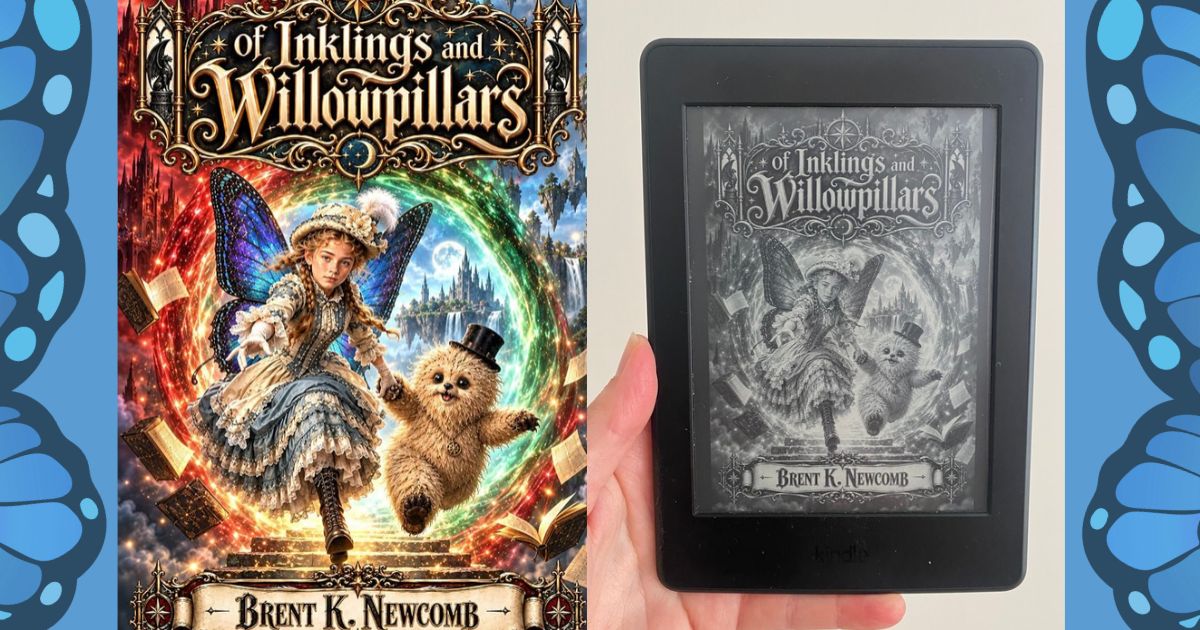
Along the way, the realms begin to change them. Edgar, who longs to be strong and fearsome, is transformed into a willowpillar, a creature resembling a cute teddy bear. His sister Charlotte grows butterfly-like wings but cannot fly. The Polycosmos, it seems, gives people what they need rather than what they asked for.
We meet:
A dark demon within a mist
A rat-like slaver captain
Ape-like animals ridden in place of horses
Ships that sail on sand
Talking murderous severed heads
A humanoid reptile king
Bumble bees the size of ponies
My Review
This book reads like it was written in another century. It’s delightful and elegant. Newcomb has described wanting Of Inklings and Willowpillars to feel as though it might actually have been published in the Victorian era rather than merely set there, and he has succeeded. The sentence structure, vocabulary, and social conventions feel period-faithful. It feels immersive.
The Title
The five children in the story call themselves the Inklings, and Newcomb playfully suggests that sixty-some years later, a certain group of literary gentlemen at Oxford might have adopted the very same name, perhaps because they knew considerably more about realm-travelling than their biographers have let on. The real Oxford Inklings were an informal literary circle active in the 1930s and 1940s, whose members included C.S. Lewis, J.R.R. Tolkien, and Charles Williams. They met at the Eagle and Child pub on Tuesday mornings, read works in progress aloud, and gave each other candid feedback. Tolkien dedicated The Lord of the Rings to the group.
Newcomb has said the book contains more than 200 Easter eggs, literary references, anagrams, acrostics, hidden meanings, homages buried several levels deep.
The Polycosmos is a system of realms controlled through a central hub (the Etherodrome) governed by three goddesses who enjoy meddling in human affairs. The realms open to travellers when they are ready, and they transform accordingly. ie. Edgar’s wish to become powerful and fearsome results instead in him becoming a willowpillar.
At 270 pages, this is a relatively compact opening to a 21-book series, which means it moves quickly and does not linger on world-building for its own sake. I think the pace works well for younger readers.
What I Liked/What I didn’t
What I liked
The Victorian narrator is immersive and feels authentic.
The book is funny, quirky, and full of imagination.
What I Didn’t
It’s a YA book, and perhaps a little young for me.
Final Verdict
Of Inklings and Willowpillars is a quick, breezy YA fantasy. It features a rich world, elegant narration and an intriguing promise of twenty more volumes.
| Format | Platform | Cost | Notes |
|---|---|---|---|
| Physical | Booktopia The Nile | Paid | Available in paperback. Both ship Australia-wide. The Nile is Australian-owned. |
| Library | BorrowBox Libby | Free | Free with a library card. Availability will vary by library -- worth requesting if it's not yet in your collection. |
| eBook | Kindle / Apple Books / Kobo | Paid | Available across all major eBook platforms. 270 pages -- a compact read well-suited to a screen. |
Q&A with Brent K. Newcomb
The title is a nod to the Oxford Inklings – C.S. Lewis, Tolkien, and their circle. How consciously were you invoking that legacy, and what does the word “inklings” mean within your own world?
Yes, the title is a nod to the historical Oxford Inklings. In fact, the connection is explained within the novel itself, although perhaps with a certain amount of mischievous literary revisionism.
The children adopt the name the Inklings, and the narrator remarks that, sixty-some years later, a group of literary gentlemen at Oxford would adopt the very same name. I deliberately left open the tantalising possibility that Lewis, Tolkien, and their companions might have known considerably more about realm-travelling than their biographers have ever suspected.
This is only one of the literary games I play with the reader. Each book contains more than 200 Easter eggs — literary references, historical allusions, anagrams, acrostics, riddles, hidden meanings, and homages to works and writers that have influenced me. Even the names of the five principal children have significance. Some references are immediately recognisable; others are buried several layers deep. A few are intended to become apparent only after reading subsequent books.
I have always enjoyed books that reward a second or third reading. I particularly love the idea that someone might discover a reference years later, suddenly make a connection, and exclaim, “Ah-ha! That’s what he was doing!” There are numerous such little traps scattered throughout the Polycosmos. I trust readers will forgive me eventually.
You’re an immigration attorney by day and a fantasy author by night. How does working with real people navigating displacement and belonging inform how you write characters crossing into other worlds?
I’ve practised law since 1999 and operated my own firm since 2001. Over those years, I’ve encountered extraordinary human stories — people separated from their families, thrust into unfamiliar societies, struggling with language, customs, laws, and institutions they may scarcely understand.
There are obvious parallels with portal fantasy, although I would never suggest that the very real hardships of immigration are equivalent to an imaginary adventure.
What connects them, for me, is the human response to unfamiliar circumstances. Remove someone from everything they’ve known, and you discover an enormous amount about that person’s character. Some become courageous. Others retreat into fear. Some discover generosity they never knew they possessed, while others are tempted by power, resentment, or self-preservation.
Ultimately, both my professional life and my fiction return to the same questions: What do we owe one another? What makes a person good? And what happens when someone must choose between doing what is easy and doing what is right?
The book is set in 1877 New England, a very specific historical anchor for a portal fantasy. What drew you to that particular time and place?
I grew up immersed in nineteenth- and early twentieth-century children’s literature, particularly the imaginative worlds of Baum, Carroll, Lewis, and other classic storytellers. I was fascinated not merely by their plots, but by the language itself — the sentence structures, vocabulary, social conventions, digressions, and wonderfully opinionated narrators.
I wanted Of Inklings and Willowpillars to feel as though it might actually have been written in another century, rather than merely being a modern fantasy in which everyone happens to wear Victorian clothing.
New England provides a fascinating counterpart. Its history, old towns, severe winters, industrial development, religious inheritance, and lingering Gothic atmosphere make it an ideal place for a story about the intrusion of the impossible into an ostensibly respectable world. New England also retained strong literary and cultural ties to Britain, particularly among its educated classes, making it a fitting American setting for a story told in the tradition of British Victorian literature.
The year 1877 places the opening adventure in an era of tremendous technological and social transformation, while retaining the atmosphere of an older, more mysterious world. It allows for a Gaslamp or Steampunk-lite feeling, as well as the haunting mysteries of a Poe lover. The historical setting grounds the fantasy. The more convincingly ordinary the world of Vanover feels, the more extraordinary the Polycosmos becomes.
What was your inspiration for the Willowpillars?
One thing that happens to certain protagonists — and antagonists — is that realm-travel physically changes a character based on his or her need.
In book one, Edgar wishes to become something powerful and fearsome, like a grizzly bear, because he believes that strength will finally make him brave enough to belong. Instead, the realm transforms him into a willowpillar — a creature that resembles a bear but possesses a distinctly gentler nature. His transformation gives him something he needs, though not necessarily what he wanted.
Charlotte, his sister, becomes a fae variant, but is unable to fly, though it is desperately needed throughout the first two books. The inspiration for the willowpillars is thus as literal an interpretation of Edgar’s condition as I could imagine. The societies, cultures, and presence throughout the whole series grew from there.
You’ve planned 21 books in this series. How much of the full arc do you have mapped out, and how do you hold that scale in your head while writing book one?
Every book in the series is written. I started in 2005-2006 and completed the entire 21 books by around 2011, and have spent the last fifteen years honing and crafting them as a unified whole. This also allows me to tweak the earlier works when needed.
The series spans generations and moves through numerous historical periods and fantastical worlds. Characters introduced in one novel may reappear much later. A seemingly inconsequential object or remark may acquire enormous significance several books afterward. The series has several two-book arcs, but also contains two trilogies and several individual stories. They are all tied together in the end.
There are two core questions I confront. The first arises from Plato’s Ring of Gyges issue, which asks whether deep down we are all evil or all good. Is virtue learned or inherent? I have my opinion on this, but you will have to read the series to find that out.
The second question is one of religion. It always bothered me that people worshipped God for the idea of a reward — the promise of Heaven — and not for His sake alone. Ber’Ebrin in my series is the ultimate realm, the paradise that many seek. But it has two firm rules: one must be worthy to enter, and one must never seek it. Those who do get realm fever and waste their lives trying to trick their way in. It is the ever-present danger in the series.
You’re also an artist. Do you visualise your characters and world visually before or after you write them? And will the series include your own illustrations?
For me, I begin with a visual concept. I have dozens of sketches of each and every character and land that I personally make, researching costumes and creating enhancements. Through this process, I begin forming the rules of the lands and the personalities of the characters. I have thousands of hand-drawn sketches for this series. When writing, I have the relevant illustrations laid out before me as a continual reminder of the uniqueness of each one.
I’ve always regarded writing and illustration as complementary forms of storytelling. As a child, I was captivated by the Oz books, particularly the wonderful illustrations of W.W. Denslow and John R. Neill. Their drawings made those imaginary places seem almost as tangible as the world outside my window.
After the first few books are up and running, I will be releasing special editions — possibly on Kickstarter — with annotations and full illustrations. Ultimately, I want readers to feel that the worlds exist beyond the edges of the printed page. If someone closes the book and can still picture the peculiar place they’ve visited, I consider that a success.
Of Inklings and Willowpillars blends YA adventure with darker themes. Who is the reader you’re writing for?
I think of the series as cross-generational fantasy, primarily for young adult and adult readers, and not conventional middle-grade fiction.
The opening novels feature children, and there’s certainly a great deal of whimsy, wonder, and absurdity. But the age of the protagonists shouldn’t be mistaken for a limitation on the intended readership. The series deals with questions of morality, temptation, power, exploitation, grief, corruption, redemption, and human nature. As the series develops, those questions become increasingly complicated, and the stories grow darker.
I wanted to capture something I admire about classic children’s literature: the willingness to enchant readers without pretending that the world is entirely benign. At the same time, I wanted adults to find deeper layers beneath the adventure. A younger reader might enjoy a fantastical creature or an extraordinary escape, while an older reader may recognise the philosophical, historical, or psychological implications of the same episode.
You reached out to book bloggers directly. What made you decide to pursue that kind of grassroots approach?
I reached out because I wanted to reach actual readers — particularly people who genuinely love books and enjoy discovering something unusual.
What appeals to me about book bloggers is that their recommendations often arise from genuine enthusiasm. They develop relationships with their audiences, and their reviews tend to offer something more thoughtful than a fleeting advertisement.
I would much rather reach a hundred people who genuinely love the world of Ber’Ebrin than a thousand who have no interest in stepping through its portals. And book bloggers, I suspect, are particularly good at finding those hundred people.
Of Inklings and Willowpillars
The first instalment in this children's fantasy novel reads like it was written in another century. Of Inklings and Willowpillars is not like anything else I've read this year.
URL: https://www.goodreads.com/book/show/258713812-of-inklings-and-willowpillars
Author: Brent K Newcomb
3.5