| Genre | Horror / Psychological Thriller |
| POV | Third person |
| Tense | Present tense |
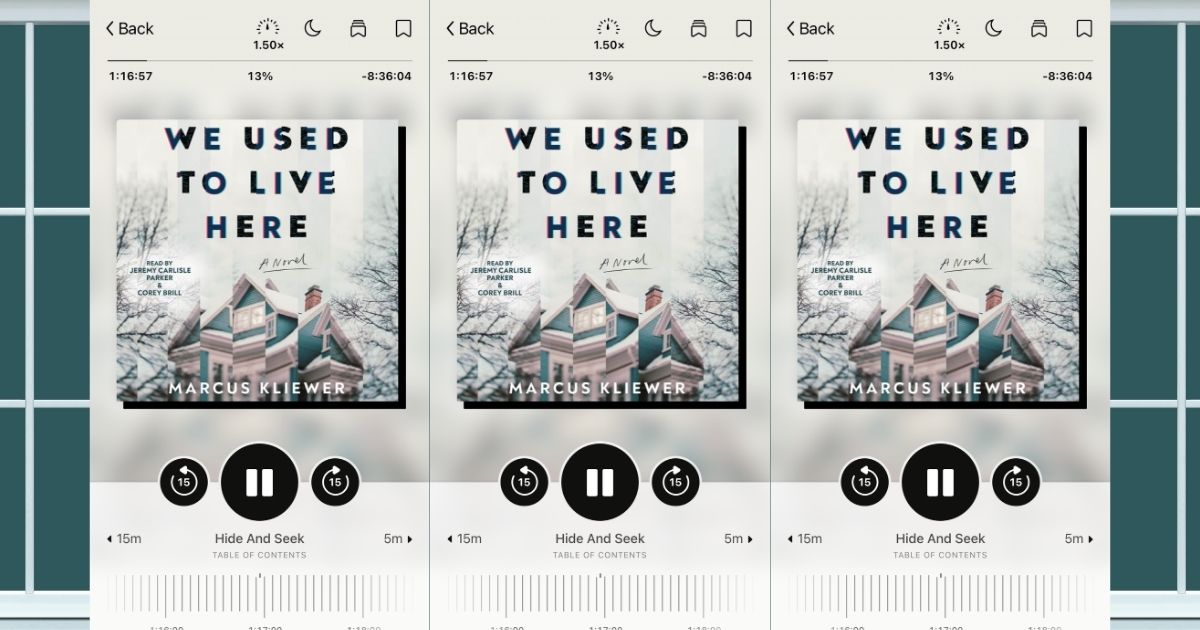
| Format | Audiobook |
| Running time | Approx. 10 hrs |
| Source | Libby (library) |
| Did I finish it? | Yes |
| My rating | 3 / 5 |
| Read if you liked | The architectural dread and impossible geometry of House of Leaves, the quiet domestic horror of We Have Always Lived in the Castle, and the documentary unease of The Magnus Archives. |
| Would I recommend it? | ✓ Yes |
We Used to Live Here started life as a Reddit post. It reads like one too, which I mean as both a compliment and a mild criticism.
Synopsis
We Used to Live Here is the debut novel of Vancouver-based writer and stop-motion animator Marcus Kliewer, published in 2024. Eve and Charlie are a young couple who flip houses for a living. Their latest purchase is an old house in the Pacific Northwest. It’s a great bargain, if slightly isolated. One day, while Charlie is out, a man named Thomas Faust knocks on the door with his wife and children in tow, claiming to have grown up in the house and asking if he can show his family around. Eve, a people-pleaser to her core, lets them in. From that point, strange things begin to happen: the house reveals rooms that shouldn’t exist, Charlie disappears, and Eve starts to lose her grip on what is real. Interspersed throughout Eve’s narrative are supplemental documents: transcripts, forum posts, and conspiracy theories about what the book calls the Old House phenomenon. A Netflix film adaptation starring Blake Lively has been announced.
My review
Before we get into it: Marcus Kliewer wrote this in the Notes app on his phone. I mention this because I am currently also reading Alchemised by SenLinYu, whose author said the same thing about her debut. I don’t know what to make of this as a trend, except that my Notes app contains book ideas and rants on the latest book I’m reading, none of which have yet attracted a Netflix deal.
The origin story of We Used to Live Here is genuinely interesting. Kliewer posted the original version to Reddit’s r/NoSleep forum, where it won the Scariest Story of 2021 award among eighteen million members. Netflix acquired the film rights before it had even been extended into a full novel, and a separate book deal with Simon & Schuster followed. The story grew from a Reddit post into a serialised series into a published debut, a non-traditional path I love to see.
The book has the energy of great creepypasta: a premise that hooks immediately, a pace that keeps moving, an atmosphere of wrongness that builds. It belongs in the tradition of forum horror, of legends that circulate in comment threads, of the particular dread that comes from a story told in fragments by people who may or may not be reliable.
The supplemental document chapters- transcripts, conspiracy forum posts, accounts from people who have encountered the Old House phenomenon add a Magnus Archives vibe.
But it also reads, at times, like a short story that has been extended to novel length. The core premise is tight enough to sustain a long short story. Stretched across a full novel, there are moments where the seams show, where the atmosphere is doing the heavy lifting that plot or character might otherwise carry.
That said, the characters are well developed, and the writing is strong. The pace is brisk, which puts it well ahead of We Have Always Lived in the Castle in terms of momentum. I found Shirley Jackson’s novel atmospheric but slow, and this is considerably more propulsive. It is nowhere near as unsettling as House of Leaves, which benefits enormously from its complete rejection of conventional narrative and its genuinely disorienting formatting. But We Used to Live Here is a decent piece of forum horror in novel form, and it largely succeeds.
I listened to the audiobook, which means I missed the Morse code easter egg hidden in the supplemental documents—each interlude apparently ends with a coded word that collectively spells out a hidden message. That’s the kind of detail that makes the physical book worth seeking out if you’re the sort of reader who likes to look for things.
On the Netflix adaptation: Blake Lively is attached to star. I’ll leave my feelings about that casting to your imagination and simply note that the book is better than whatever the adaptation will probably be.
What I liked / what I didn’t
What I liked
The premise is tight, and the atmosphere is well-constructed. The supplemental document chapters add something more modern and fun and suit the audiobook format well (in spite of my missing the Morse code). The pacing is brisk; this is a quick, fun horror read that doesn’t outstay its welcome. The characters are well developed for the genre.
What I didn’t
The book’s Reddit origins are both its greatest strength and its limitation. It has the energy and atmosphere of great creepypasta, but it also reads like a short story that has been expanded to fill a novel. For readers coming from House of Leaves expecting that level of formal experimentation and sustained dread, this will feel lighter than expected. The ending divides readers significantly, and I can see why.
Final verdict
We Used to Live Here is a solid, enjoyable horror debut that is best understood for what it is: elevated forum horror, transferred successfully from Reddit to the page, with a strong atmosphere and a premise that delivers. I’d recommend it to anyone who loves the genre, but not as a first horror recommendation for someone new to it, and not as a replacement for the books it most resembles. Think of it as a very good companion read to House of Leaves or The Magnus Archives rather than a successor to either. Borrow it from the library first. It’s worth the short waitlist. I’d also recommend The Staircase in the Woods, if you like this.
Where to Find it in Australia
| Format | Platform | Cost | Notes |
|---|---|---|---|
| Physical | Booktopia The Nile | Paid | Available in paperback. Both ship Australia-wide. The Nile is Australian-owned. Worth borrowing first given the divisive ending. |
| Library | Your local library BorrowBox Libby | Free | Free with a library card. This is where I borrowed the audiobook -- there was a short waitlist but nothing significant. Strongly recommend borrowing before buying. |
| eBook | Booktopia Kindle / Apple Books / Kobo | Paid | Available across all major eBook platforms. Worth noting the physical book has design flourishes that don't carry across to digital -- the Morse code easter egg in the supplemental documents is best experienced in print. |
| Audiobook | Audible AU Libby (library)* BorrowBox (library)* | Paid / Free* | Not author-narrated. Runs approx. 10 hrs. This is the format I listened to and it works well -- the supplemental document chapters benefit from having a distinct narrator voice. Free via Libby or BorrowBox if your library carries it. |
| Netflix | Netflix (coming soon) | Paid | A Netflix film adaptation starring Blake Lively has been announced. No confirmed Australian release date at time of writing. |
* Free with a valid Australian library card where available through your library's Libby or BorrowBox partnership.