

| Genre | Literary Fiction |
| POV | First person |
| Tense | Past tense |
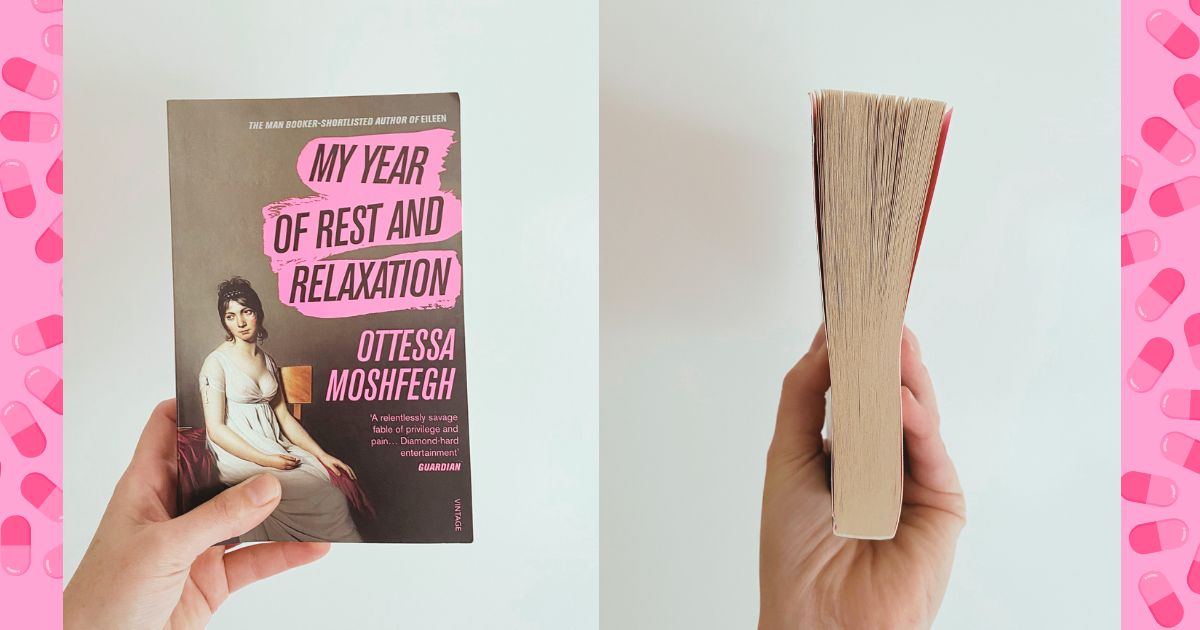
| Format | Paperback |
| Source | Borrowed from a friend |
| Did I finish it? | Yes |
| My rating | 3 / 5 |
| Read if you liked | The dreamlike interiority and dark humour of Bunny and the oppressive, restricted world of Really Good Actually. |
| Would I recommend it? | ✓ Yes |
My Year of Rest and Relaxation is a book I admired more than I enjoyed.
Synopsis
My Year of Rest and Relaxation is Ottessa Moshfegh’s second novel, published in 2018 and set in New York City in the year 2000. The narrator is unnamed, young, thin, pretty, a recent Columbia graduate, and very, very bored with being alive. Newly orphaned and adrift from any real purpose, she decides to spend a year sleeping, aided by a pharmacopoeia prescribed by NY’s worst psychiatrist.
The novel follows her hibernation: the blackouts, the brief surfacings, the chaotic relationship with her best friend Reva, and the slow drift.
My review
This is a book that feels like it was written from somewhere very deep inside Moshfegh’s subconscious. Like, she sat in front of a blank page and just WROTE. And I love that. The writing is gorgeous; genuinely, occasionally startlingly so. She has a way of nailing the texture of a thought or a sensation that is hard to describe, except to say that it lands. Reading it, I kept thinking: this is what it feels like when a writer lets their instincts run further than their conscious mind.
However, the plot is thin.
Not thin in the way that literary fiction is sometimes thin. The narrator sleeps. She wakes briefly. She sleeps again. There are excursions, there is Reva, there is the Dr Tuttle dispensing medications. But the world of this book is very small, and it is almost entirely interior. Memories, thoughts, feelings, the oppressive texture of a mind that has decided to opt out.
This is, I think, intentional. The claustrophobia is the point. The reader is meant to feel what the narrator feels: the heaviness, the restricted world, the slight unreality of a life being deliberately sedated. In that sense, it works. It worked on me, in the sense that by page 240, I was skimming and ready for it to be over, which is probably exactly how the narrator feels about being awake. Whether that’s a feature or a flaw depends entirely on what you want from reading.
I’ve had a similar experience with Really Good Actually by Monica Heisey, a book I appreciated intellectually, written with a deliberately restricted and oppressive interiority, where the confined world of the narrator eventually started to press on me as a reader. However, that book I DNF’d. Both books are doing something purposeful with that confinement. Both eventually made me want out.
Three stars is not a dismissal. The writing alone earns more than that. But I didn’t love this book, and I’m not sure I was meant to. I’m not sure anyone is.
What I liked / what I didn’t
What I liked
The writing is exceptional; precise, strange, deeply interior in a way that is genuinely hard to achieve. Moshfegh writes thoughts and sensations with an accuracy that stops you mid-sentence. The character of Dr Tuttle is darkly funny, and the novel’s black humour is consistent and well-judged throughout. As a piece of literary craft, it is impressive.
What I didn’t
The plot is so thin that by the final third, I was skimming. The confined, interior world that makes the book distinctive eventually becomes oppressive in a way that works against sustained reading. This is probably intentional, but intentional discomfort is still discomfort.
Final verdict
My Year of Rest and Relaxation is worth reading if you enjoy literary fiction that takes risks and trusts its own strangeness. The writing feels genuinely singular rather than simply polished. But go in knowing that the plot is almost nothing, the world is very small, and the experience is designed to press on you in ways that are not always comfortable. I’d recommend it, with that caveat. I’m just not entirely sure who I’d recommend it to; probably someone who liked Bunny, or Really Good Actually, or who is comfortable spending time in a narrator’s head even when that head is a fairly unpleasant place to be.
Where can I read it?
| Format | Platform | Cost | Notes |
|---|---|---|---|
| Physical | Booktopia The Nile | Paid | Available in paperback. Both ship Australia-wide. The Nile is Australian-owned. Worth borrowing before buying given the very specific type of reader this suits. |
| Library | Your local library BorrowBox Libby | Free | Free with a library card. Strongly recommend borrowing before buying -- this is a book you'll know quickly whether it's for you. |
| eBook | Booktopia Kindle / Apple Books / Kobo | Paid | Available across all major eBook platforms. At 289 pages, a manageable screen read. |
| Audiobook | Audible AU Booktopia Libby (library)* | Paid / Free* | Not author-narrated. Narrated by Julia Whelan. Runs 7 hrs 14 mins. Free via Libby or BorrowBox if your library carries it. |
* Free with a valid Australian library card where available through your library's Libby or BorrowBox partnership.