At a glance
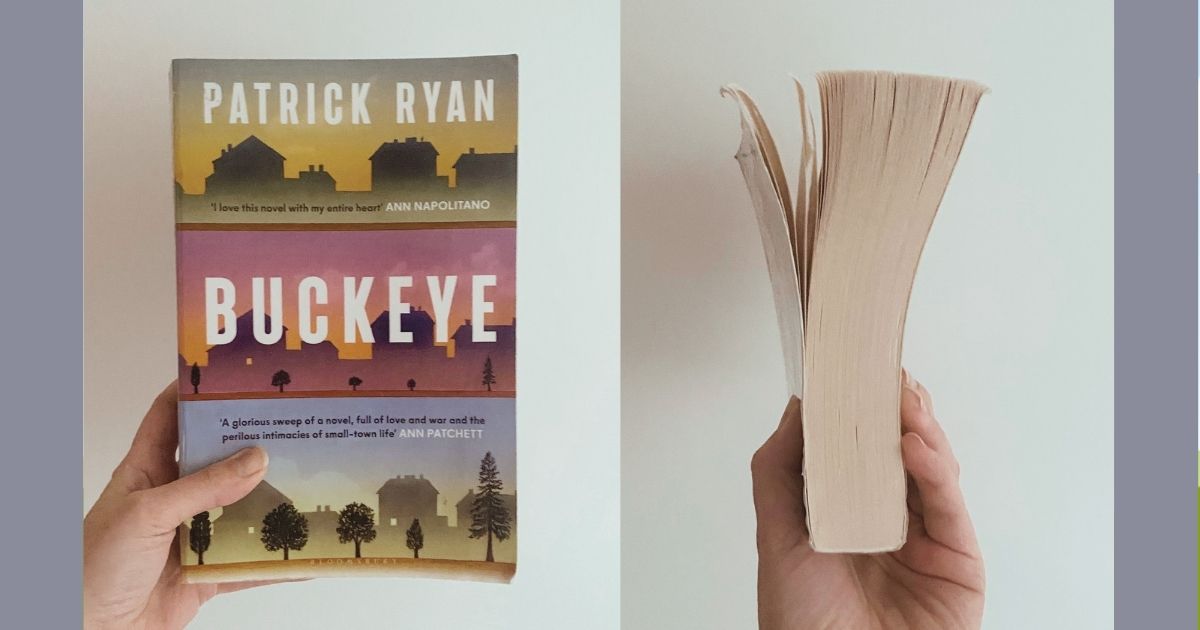
Buckeye
Patrick Ryan


| Genre | Historical Literary Fiction |
| POV | Third person omniscient |
| Tense | Past tense |
| Format | Paperback |
| Source | Local library |
| Did I finish it? | Yes |
| My rating | 3 / 5 |
| Read if you liked | The quiet small-town American heart of Ordinary Grace and the literary weight and moral complexity of A Prayer for Owen Meany. |
| Would I recommend it? | ✓ Yes |
Buckeye is a beautifully researched, immersive piece of historical fiction that pulls you convincingly into small-town Ohio across four decades. However, I found it long, and didn’t particularly enjoy the omniscient narrative.
Synopsis
Buckeye is Patrick Ryan’s debut novel for adults, set in the fictional town of Bonhomie, Ohio. It opens in May 1945, on the day news of the Allied victory in Europe arrives, with a brief encounter between two people: Margaret Salt, a woman with a complicated past, and Cal Jenkins, a man whose inability to serve in the war has left its own kind of wound. That encounter sets off a secret that will ripple through both their families for the next four decades. The novel spans from the post-war boom through the Vietnam era, following two intertwined families as they navigate marriage, parenthood, loss, and the particular weight of things left unsaid in a town where nothing stays buried forever.
My review
There is real craft in this book. Ryan can write a truly beautiful sentence. I noted three quotes as I read. See further down.
The world of Bonhomie is immersive and well-researched, the historical detail worn lightly enough that it never feels like homework.
And yet I found myself, somewhere around page 300, checking how many pages were left. That is rarely a good sign.
The issue, for me, is the narrative point of view. Buckeye shifts between third-person limited and third-person omniscient—sometimes staying close to a character’s perspective, sometimes pulling back to a wider, more knowing vantage point. In theory, this can work. In practice, here, it meant I never quite settled into anyone. Just as I was beginning to feel properly inside a character’s experience, the camera pulled back. The effect is what I can only describe as diluted. There are a lot of characters, and the omniscient perspective means we dip in and out of each of them without ever quite landing. I found myself not disliking any of them exactly, but not fully rooting for any of them either. A mild, ambient ambivalence toward the whole cast.
I noticed some reviews on Goodreads with general feedback in this area: “I couldn’t find one character to care about / The characters felt surface level / tedious and the characters are not particularly compelling…”
And, in spite of the very strong 4+/5 overall rating, I found myself agreeing with these lone reviewers.
This is a particular frustration for me as someone who writes and has sat through enough workshops and writing classes to know the conventional wisdom: stay close to your point of view, earn your access to other characters’ interiority. And then a book like this comes along, breaks those rules, gets blurbed by Ann Napolitano and Ann Patchett, lands on the New York Times bestseller list, and sells in significant numbers. I know this is how it works. Sigh.
To be clear: this is not a bad book. It is a good book that kept me at arm’s length. The writing is frequently lovely. The setting is vivid.
The themes:
- forgiveness,
- family,
- the impact of secrets
are handled with genuine compassion.
What I liked / what I didn’t
What I liked
The prose is genuinely beautiful: precise, evocative, and occasionally stunning. The historical world-building is immersive without being heavy-handed. The setting of Bonhomie feels real and specific, and the themes of forgiveness and family consequence are handled with real care. The book is well worth reading if literary fiction is your genre.
What I didn’t
The shifting between third-person limited and omniscient narration meant I never fully settled into any one character. With a large cast and a narrative perspective that keeps pulling back just as you’re getting close, the characters feel diluted rather than fully inhabited.
Favourite quotes
“His letters, they realised, were like light from a star, momentarily comforting but independent of a source that might no longer be there.”
“Her eyes are lively, but the skin that holds them in place looks like it might be tired from doing so.”
“She yearned for a life wherein a woman could have an unusual talent and not be thought of as a nuisance.”
Final verdict
Buckeye is fine. It’s a thoughtful, well-crafted piece of historical literary fiction with writing that occasionally stops you in your tracks. But it kept me at a distance I couldn’t quite close, and for a book of this length, that distance accumulates. I’d recommend it to readers who love literary fiction and are patient with large, multi-character, multi-decade sagas. I wouldn’t hand it to just anyone. It’s worth about three and a half stars; I’m rounding down only because I spent the last 150 pages wanting it to be over.
Where can I read it?
| Format | Platform | Cost | Notes |
|---|---|---|---|
| Physical | Booktopia The Nile | Paid | Available in paperback and hardcover. Both ship Australia-wide. The Nile is Australian-owned. This is the format I read -- borrowing from the library first is recommended. |
| Library | Your local library BorrowBox Libby | Free | Free with a library card. Worth borrowing before buying given the qualified recommendation. Check your local catalogue for physical copies. |
| eBook | Booktopia Kindle / Apple Books / Kobo | Paid | Available across all major eBook platforms. At 448 pages, a reasonable screen read. |
| Audiobook | Audible AU Google Play Books Libby (library)* | Paid / Free* | Not author-narrated. Narrated by Michael Crouch. Runs 15 hrs 44 mins. Free via Libby or BorrowBox if your library carries it. |
* Free with a valid Australian library card where available through your library's Libby or BorrowBox partnership.