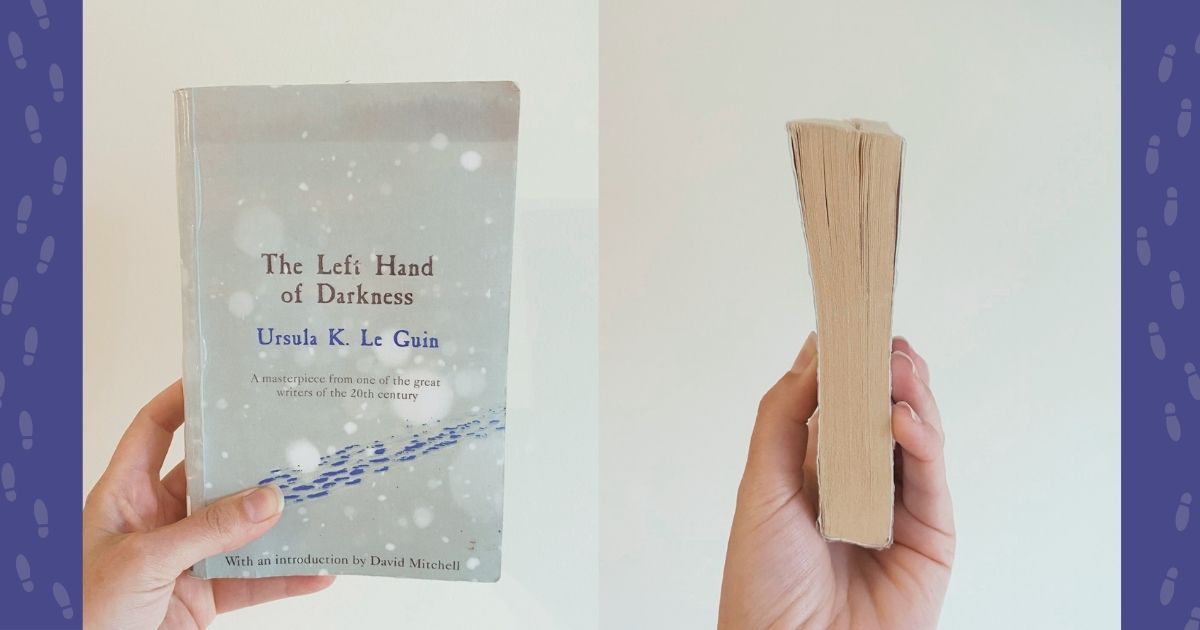
At a glance
The Left Hand of Darkness
Ursula K. Le Guin


| Genre | Science Fiction / Literary Fiction |
| POV | First person |
| Tense | Past tense |
| Format | Paperback |
| Source | Local library |
| Did I finish it? | Yes -- 19 to 31 August |
| My rating | 2 / 5 |
| Read if you liked | The dense, immersive world-building of Dune and the anthropological intimacy and cultural alienation of The Sparrow. |
| Would I recommend it? | ✕ No |
The Left Hand of Darkness won the Hugo and Nebula Awards in 1970. It’s feminist science fiction, and it influenced generations of writers. I gave it two stars.
Synopsis
The Left Hand of Darkness was published in 1969 and is infamous as a piece of science fiction. Genly Ai is a lone, human envoy sent to the planet Gethen, aka Winter, with a mission to invite the planet to join an interplanetary alliance.
The Gethenians are androgynous; they have no fixed gender, shifting between male and female during a biological cycle, and Genly, shaped by his own assumptions about gender and identity, struggles to understand them. He becomes entangled in the political machinations of two rival nations, forms an unlikely alliance with Estraven, a Gethenian politician who has fallen from favour. The two eventually join forces and work together to cross eight hundred miles of glacial ice to survive. The relationship that forms during that crossing is the emotional heart of the novel.
My review
Ursula K. Le Guin was the daughter of Alfred Kroeber, one of the most eminent anthropologists of the 20th century, who studied under Franz Boas, the father of American anthropology. Her mother, Theodora Kroeber, was also a writer. Le Guin grew up in a household where the study of culture, identity, and what it means to encounter a radically different society was dinner table conversation.
The Left Hand of Darkness mimics the structure of anthropological fieldwork, weaving folklore, oral histories, and cultural reports into the main narrative.
It has been cited by generations of writers as a core influence.
Stephen King called her “a literary icon, not just a science fiction writer.” Margaret Atwood described her as “one of the literary greats of the 20th century.” Neil Gaiman wrote that he “would rather have been chided by Ursula K. Le Guin than effusively praised by any other living author.” Writers including Salman Rushdie, George R.R. Martin, David Mitchell and Atwood have all cited her as a formative influence.
I’m highlighting her beloved feedback to apologise for not liking the book. This is not a bad book. It is a great book that is not for me.
In fact, Left Hand of Darkness raised questions about gender as a social construct that were genuinely radical in 1969 and remain relevant now. Le Guin later reflected critically on her own choices: she used “he” as the default pronoun for the genderless Gethenians, a decision she came to feel was itself shaped by the assumptions she was trying to question. She subsequently wrote companion stories using “she” instead. That level of self-examination from a writer of her stature is unusual and worth acknowledging.
In her essay “Is Gender Necessary? Redux,” Le Guin reflected critically on her use of “he” as the default pronoun for the genderless Gethenians. She later wrote that had she “realized how the pronouns I used shaped, directed, controlled my own thinking, I might have been cleverer.” She subsequently wrote companion stories using “she” instead.
The central problem I had is pacing and density. The Left Hand of Darkness is a book where the world-building is key. I understand that intellectually. But experiencing it over two hundred pages before the story I had been promised by the blurb materialised was a test of patience. I was close to DNF-ing, and only didn’t due to the book’s legendary status.
Quotes from the novel
“We had, very roughly, eight hundred miles to go. The first hundred would be north or northeast, going through the forest and across the northernmost spurs of the Sembensyen range to the great glacier, the ice-sheet that covers the double-lobed Great Continent everywhere north of the 45th parallel, and in places dips down almost to the 35th. One of these southward extensions is in the region of the Fire-Hills, the last peaks of the Sembensyens, and that region was our first goal. There among the mountains, Estraven reasoned, we should be able to get onto the surface of the ice-sheet, either descending onto it from a mountain-slope or climbing up to it on the slope of one of its effluent glaciers. Thereafter we would travel on the Ice itself, eastward, for some six hundred miles. Where its edge trends north again near the Bay of Guthen we would come down off it and cut southeast a last fifty or a hundred miles across the Shenshey Bogs, which by then should be ten or twenty feet deep in snow, to the Karhidish border.”
“One palliative of winter on Winter is that the days stay light. The planet has a few degrees of tilt to the plane of the ecliptic, not enough to make an appreciable seasonal difference in low latitudes. Season is not a hemispheric effect but a global one, a result of the elliptoid orbit. At the far and slow-moving end of the orbit, approaching and departing from aphelion, there is just enough loss of solar radiation to disturb the already uneasy weather patterns, to chill down what is cold already, and turn the wet gray summer into white violent winter. Dryer than the rest of the year, winter might be pleasanter, if it were not for the cold. The sun, when you see it, shines high; there…”
The quotes above are examples: dense paragraphs of invented geography, planetary science explained in academic terms, compass bearings across fictional mountain ranges. This is a lot of the book. If that kind of immersive density in science fiction, this book is for you. For me, it was where I got lost.
The blurb promises a relationship. Specifically, it promises that Genly and Estraven’s journey across the ice will be the heart of the story. But it arrives around 75% in. The preceding three quarters are politics, lore, folklore interludes, cultural reports, and geography. The relationship between Genly and Estraven that I was waiting for, the one the blurb centres, is more engrossing when it finally arrives.
Le Guin, like Mary Doria Russell, uses speculative fiction as a vehicle for exploring what it means to encounter a truly alien culture. Her deep grounding in anthropology gives that encounter a rigour that most science fiction cannot match. The parallel between the two authors is not accidental: both had significant anthropological influences shaping their work, and both wrote novels that function as much as cultural studies as they do stories. I thoroughly recommend Russell’s The Sparrow, which I enjoyed immensely.
I simply was not the right reader for this one.
What I liked / what I didn’t
What I liked
The final quarter of the book: the ice crossing and the relationship between Genly and Estraven. Le Guin’s anthropological framework gives the world of Gethen an impressive level of immersion and specificity. The central concept, a genderless society that forces the reader to examine their own assumptions, was, and remains, an interesting premise and one I enjoyed.
What I didn’t
The density of the world-building. The blurb centres a relationship that does not meaningfully develop until the final quarter. This is a book for patient, committed readers of literary science fiction.
Final verdict
The Left Hand of Darkness is a landmark work of science fiction that I cannot personally recommend. Two stars reflect my experience of reading it, not the book’s significance. If you love dense, anthropologically rich world-building, if Dune felt like home or The Sparrow left you wanting even more, this may be exactly what you are looking for. If you are like me and find that kind of density loses you, start somewhere else and come back to this one when you are ready for it.
Where can I read it?
| Format | Platform | Cost | Notes |
|---|---|---|---|
| Physical | Booktopia The Nile | Paid | Available in paperback. Both ship Australia-wide. The Nile is Australian-owned. This is the format I read -- borrowed from my local library. |
| Library | Your local library BorrowBox Libby | Free | Free with a library card. Given the qualified recommendation, borrowing before buying is strongly advised. This has been in print since 1969 and should be well stocked at most libraries. |
| eBook | Booktopia Kindle / Apple Books / Kobo | Paid | Available across all major eBook platforms. |
| Audiobook | Audible AU Libby (library)* BorrowBox (library)* | Paid / Free* | Not author-narrated. Narrated by George Guidall. Runs approx. 9 hrs 45 mins. Note: some listeners find the narration style flat -- worth sampling before committing. Free via Libby or BorrowBox if your library carries it. |
* Free with a valid Australian library card where available through your library's Libby or BorrowBox partnership.
The Left Hand of Darkness
A landmark of feminist sci-fi. My honest 2-star review of The Left Hand of Darkness and where to find it in Australia.
URL: https://www.goodreads.com/book/show/118028.The_Left_Hand_of_Darkness
Author: Ursula Le Guin
2