

| Genre | Epic Fantasy |
| POV | Third person limited |
| Tense | Past tense |
| Format | eBook (Kindle) |
| Source | Purchased (Amazon) |
| Did I finish it? | Yes -- 31 August to 29 September |
| My rating | 4 / 5 |
| Read if you liked | The deeply rich characters and propulsive plotting of The Lies of Locke Lamora, the ludicrously capacious weight of Jonathan Strange & Mr Norrell, and the intimate character-driven fantasy of Assassin's Apprentice. |
| Would I recommend it? | ✓ Yes |
I don’t love fantasy. I find it often buries me in lore, geography, invented politics, and thousands of years of history that I don’t feel enhance the book. I’ve been resisting Robin Hobb’s Liveship Traders trilogy for years, partly for this reason, and because, frankly, it’s enormous. But it kept appearing on the shelves of BookTokers and Bookstagrammers.
I caved.
Thirty days later, four stars, and I am immediately reading the next one.
Synopsis
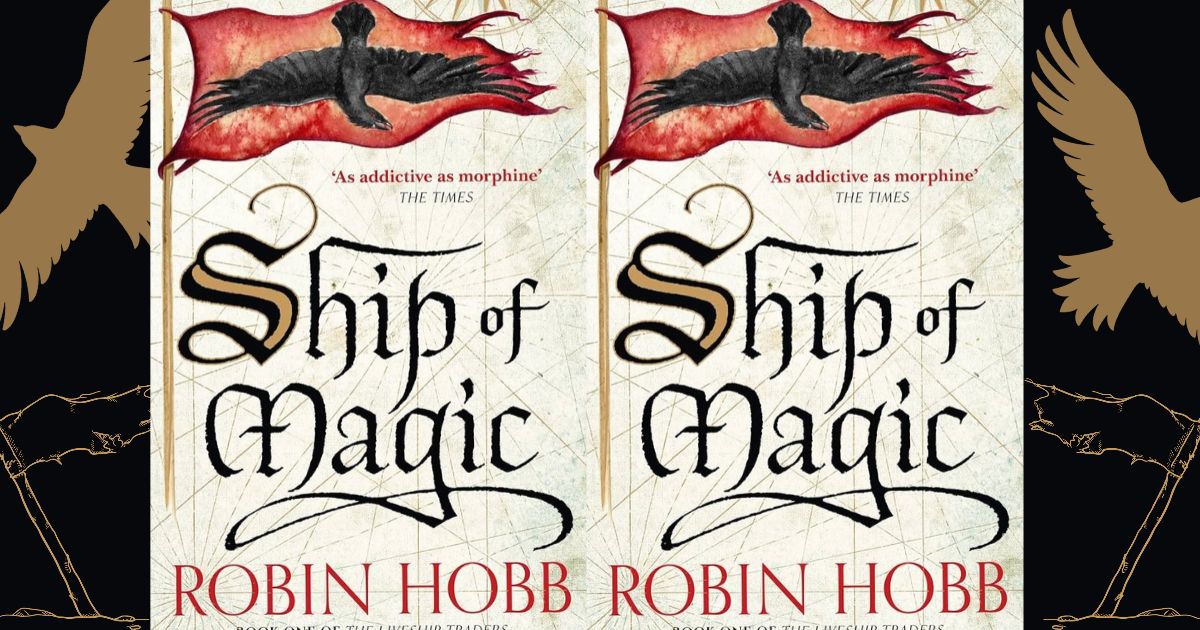
Ship of Magic is the first book in Robin Hobb’s Liveship Traders trilogy, published in 1998. The Vestrit family of Bingtown own a liveship, a rare vessel made of wizardwood that quickens into sentience when three generations of the owning family die on its deck. When patriarch Ephron Vestrit dies aboard Vivacia, the ship awakens, and everything the family assumed about their future shifts. Althea Vestrit, who has sailed with her father since childhood and considers Vivacia her birthright, finds herself dispossessed by her brother-in-law Kyle Haven, a man with very different ideas about trade, family, and what a liveship is for. Running parallel is the story of Captain Kennit, a pirate with a grand ambition: to become King of the Pirate Isles, and he needs a liveship to do it. Not to mention Althea’s mother, sister, nephew and niece, a sex worker named Etta, Sorcor and Brashen, and the ships themselves: Vivacia, Paragon, Ophelia.
The stories of the characters are drawn together immaculately, and it’s a fun ride.
My review
TIL: Robin Hobb is not her real name. Her name is Margaret Astrid Lindholm Ogden. She wrote for years as Megan Lindholm. She adopted Robin Hobb in 1995, choosing something androgynous to match the first-person male narrator of her Farseer books. The name Hobb was chosen for its similarity to fantasy folk—hobbits, hobgoblins. She won the World Fantasy Award for Life Achievement in 2021.
Her husband is a marine engineer, and she has spent much of her life in close proximity to the sea and working ships. I don’t know much about ships, but the writer of this book appears to, and her maritime background makes complete sense; it shows in the authenticity of the understanding of ships, the culture of the traders, the texture of life on the water. In a 2018 New Statesman interview, Hobb revealed that the character Brashen was named after one of the best deckhands her husband ever worked with. And, like George R.R. Martin’s Khaleesi, there are now children named after Brashen and his lover Althea. Literary immortality.
The Liveship Traders is the second trilogy in the Realm of the Elderlings, Hobb’s 16-book fantasy universe spanning five interconnected series:
- Farseer,
- Liveship Traders,
- Tawny Man,
- Rain Wild Chronicles,
- and Fitz and the Fool.
Several critics regard the Liveship Traders as her best work. The New Statesman wrote that Hobb’s novels did not ignore women’s stories, praising the “striking portraits of three generations of women” in the trilogy. The Times called her writing “as addictive as morphine.”
Screen Rights
Film rights have been sold, but Hobb has noted: they would “most likely never get made.”
I don’t love fantasy. I find the genre often buries you in lore. A writer will take you to a new land and explain its politics, its thousands of years of history, its tribes, its animals, its invented geography, and by the time the story starts I’ve lost the thread.
But Hobb does it well.
The world of Bingtown, the Rain Wild River, the Pirate Isles, the mechanics of how a liveship quickens: there is a lot of world there. But she stays on the right side of it. It is immersive without being overwhelming.
The thirty days this took me is not a reflection of my engagement; it is a reflection of the book’s size and my life. I was reading it alongside a post-holiday work backlog and Melbourne school holidays. It is a large book. But it’s worth it.
What Hobb does particularly well is create characters who are interesting and flawed, making terrible decisions you can completely understand. You are rooting for them while also watching them sabotage themselves. There are no clean heroes here. Althea is fierce and driven and occasionally blind to her own privilege. Kyle is a villain whose logic is internally consistent, yet you can see what he’s trying to achieve. Kennit is a pirate whose ambition and charm make him compelling even as he is clearly monstrous. And the liveships: Vivacia, Paragon, Ophelia, are characters in their own right, with their own histories and wounds.
What I also enjoyed is the structure. Each character’s story is separate for most of the book, moving in parallel, and you can feel the narrative slowly drawing them toward each other. By the end of book one, the threads are beginning to touch. It is the kind of architecture that makes you immediately want the next book, which I do.
What I liked / what I didn’t
What I liked
The characters are extraordinary: flawed, driven, and morally complicated. The world-building is immersive without being suffocating. The parallel narrative structure, with separate storylines slowly converging, creates a sustained tension that keeps you invested across a very long book. The liveships as sentient characters are a gorgeous concept.
What I didn’t
Not a lot. Four stars is genuine. If I’m stretching: the book is large, and the early sections require patience while the world establishes itself.
Final verdict
Ship of Magic took me thirty days. I would have read it faster if life had allowed. I will read the next one (when I can get to it!).
Recommended. Especially if you are a fantasy sceptic who has been circling this series for years, as I was. The Times was right.
Where can I read it?
| Format | Platform | Cost | Notes |
|---|---|---|---|
| Physical | Booktopia The Nile | Paid | Available in paperback. Both ship Australia-wide. The Nile is Australian-owned. This is a chunky book -- worth checking your library before buying. |
| Library | Your local library BorrowBox Libby | Free | Free with a library card. Has been in print since 1998 and should be well stocked. Worth borrowing before committing to the full trilogy. |
| eBook | Kindle (Amazon AU) Apple Books / Kobo | Paid | Available across major eBook platforms. This is the format I read -- for a book this long, an e-reader is the sensible choice. |
| Audiobook | Audible AU Libby (library)* BorrowBox (library)* | Paid / Free* | Not author-narrated. Narrated by Anne Flosnik and Lucy Tregear. Given the size of the book, audio may be the most practical format for busy readers. Free via Libby or BorrowBox if your library carries it. |
* Free with a valid Australian library card where available through your library's Libby or BorrowBox partnership.
Ship of Magic
I don't love fantasy. I find the lore, the geography, the invented politics (all of it) tends to bury me. But Robin Hobb drew me in. I loved this book.
URL: https://www.goodreads.com/book/show/12479384-ship-of-magic
Author: Robin Hobb
4