At a glance
The Poet
Michael Connelly
| Genre | Crime Fiction / Thriller |
| Format | Paperback (1996 edition) |
| Source | Gifted |
| Did I finish it? | Yes |
| My rating | 3 / 5 |
| Read if you liked | The relentless procedural grip and serial killer tension of Along Came a Spider. |
| Would I recommend it? | ✓ Yes |
The Poet is a perfectly decent 1996 thriller that has aged in the way that only a book published in 1996 could. The story is good. The vibe is extremely, inescapably, dial-up internet era.
Synopsis
The Poet is the first book in Michael Connelly’s Jack McEvoy series, published in 1996. Jack is a crime reporter for the Rocky Mountain News in Denver whose twin brother (a homicide detective) is found dead, apparently by suicide. Jack doesn’t buy it, and when he starts investigating, he discovers his brother may be one of a string of cops across the country who have been murdered and made to look like suicides, each death accompanied by a quote from Edgar Allan Poe. Jack manages to liaise his way into an FBI investigation, chasing the story of his career while. It is a standalone thriller, though Connelly brought Jack back in The Scarecrow in 2009.
My review
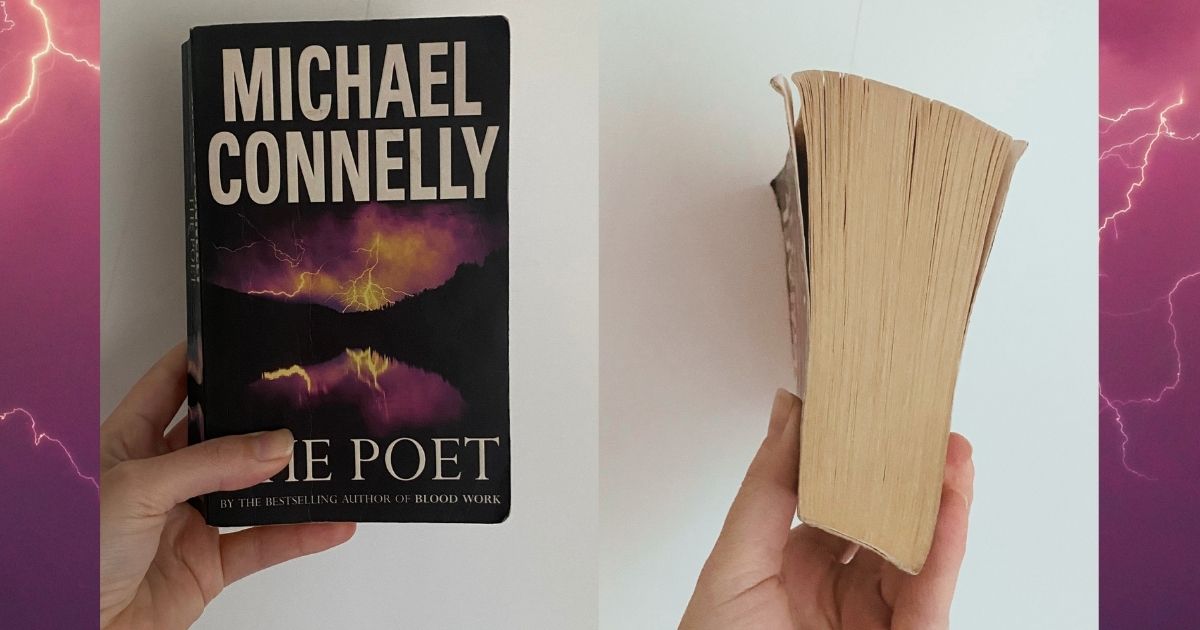
Someone gifted me a 1996 paperback copy of this, and I want to be clear that reading a 1996 edition of a 1996 book is a very specific experience. The pages are yellowed and soft (which I love), not to mention the old-style smaller book sizing. The cover art is extremely of its time, as are the many, many, many antiquated references: the primary being just how many times this character references ‘making love’.
The Poet is so thoroughly, helplessly mid-90s that it almost loops back around to being charming. The Rocky Mountain News journalists are racing to break stories before rival newspapers with no apparent awareness that within fifteen years the entire industry would be in free fall, and the Rocky Mountain News itself would be gone. The technology is faxes, pagers, landline phones, dial-up internet connections, and the very first commercially available digital cameras, rendered with the wide-eyed excitement of people discovering electricity. It feels like another lifetime ago, but to my horror, I lived through this very decade.
But here is the thing: strip away the period details, and the actual story is pretty good. The premise: a serial killer targeting homicide cops and staging their deaths as suicides, leaving Poe quotes as calling cards, is genuinely clever. The pacing is solid. Connelly knows how to construct a thriller, and the plot moves with enough momentum to keep you turning pages even when Jack is doing something spectacularly self-sabotaging. There are a couple of good twists toward the end that you can see coming to some extent with so many pages left to go and the main storyline wrapped up.
The main character, Jack, is unreliable and unlikeable, though I can’t tell if that was the author’s intention or not. He makes decisions that are professionally and ethically indefensible, and he keeps getting away with it in a way that only fictional journalists in the 1990s could. Every time he does something questionable, the narrative essentially shrugs.
The whole thing has the energy of a 90s movie that never got made. Ashley Judd and Brad Pitt were waiting in the 90s wings for the heavy score, amber colour grading, and the slightly too-long movie of the same name. It would have done well at the box office in 1997 and been mostly forgotten by 2001. That is not an insult. That is just what this book is.
What I liked / what I didn’t
What I liked
The central premise is inventive and well-constructed. The pacing is confident: Connelly knows how to keep things moving. And the twists in the final act land better than expected. As a window into mid-90s American newsrooms and law enforcement culture, it is also, unintentionally, a fascinating document.
What I didn’t
The book’s 90s-ness, while occasionally fun, does date it significantly. The technology, the dialogue, and a certain earnestness around the central romance all feel like artefacts from another era. Which, of course, they are.
Final verdict
The Poet is a fine thriller with a clever premise and a main character who makes you want to shake him every forty pages or so. I finished it, I didn’t regret it, and I can see why it launched Connelly’s career beyond the Harry Bosch series. But would I actively recommend it? Only with a caveat: if you’re seriously into crime fiction and you’re after something with genuine procedural bones, it holds up reasonably well. If you’re new to the genre, start somewhere that wasn’t published the year the Macarena was number one.
Connelly did bring Jack back in The Scarecrow in 2009, where, appropriately, he’s reporting on the death of print journalism. I’ll let you sit with that irony.
Where can I read it?
| Format | Platform | Cost | Notes |
|---|---|---|---|
| Physical | Booktopia The Nile | Paid | Available in paperback. Both ship Australia-wide. The Nile is Australian-owned. Note: multiple editions exist -- the current paperback is the one to buy rather than hunting down a 1996 copy like I was gifted. |
| Library | Your local library BorrowBox Libby | Free | Free with a library card. Worth borrowing before buying given the qualified recommendation. Check your local catalogue -- it's been in print long enough to be well stocked. |
| eBook | Booktopia Kindle / Apple Books / Kobo | Paid | Available across all major eBook platforms. At 480 pages, a reasonable screen read. |
| Audiobook | Audible AU Booktopia Libby (library)* | Paid / Free* | Narrated by Buck Schirner. Not author-narrated. Runs 15 hrs 24 mins. Reviewer opinions on the narration are mixed -- some find it perfectly suited to the procedural tone, others less so. Free via Libby if your library carries it. |
* Free with a valid Australian library card where available through your library's Libby or BorrowBox partnership.
The Poet by Michael Connelly: A Book Review
At a glance
URL: https://www.goodreads.com/book/show/32506.The_Poet
Author: Michael Connelly
3