At a glance
Weyward
Emilia Hart
| Genre | Literary Fiction / Historical Fiction |
| Format | Audiobook |
| Source | Libby (library) |
| Did I finish it? | Yes -- over 6 days |
| My rating | 3 / 5 |
| Read if you liked | The quiet literary weight of Small Things Like These and the folklore-drenched dread of The Good People. |
| Would I recommend it? | ✕ No |
Weyward is beautifully written, competently constructed, and tells a story that has been told before. That’s not a dealbreaker, but it is the thing that kept me at arm’s length from a book I wanted to love.
Synopsis
Weyward weaves together three timelines across five centuries, each following a woman from the same family bloodline. In 2019, Kate flees an abusive relationship in London for a remote Cumbrian cottage inherited from a great-aunt she barely knew. In 1942, Violet chafes against the rigid expectations of her father and longs for something beyond the walls of her family’s crumbling estate. In 1619, Altha stands trial for witchcraft, accused of causing the death of a local man. All three women share a strange connection to the natural world: to insects, animals, and the land itself, and all three are held down, in one way or another, by the men around them. This is Emilia Hart’s debut novel.
My review
Hart’s prose is genuinely lovely: visceral, sensory, grounded in the physical world in a way that makes the Cumbrian countryside feel present and breathing. She writes about light, texture, and the small details of nature with real skill. There are insects everywhere: their wings, their delicate structures, their brief lives. It’s intentional, and for a while it’s effective. By the end, it tips into repetition. One too many fragile wings catches the light, and you start to notice the tic rather than the image.
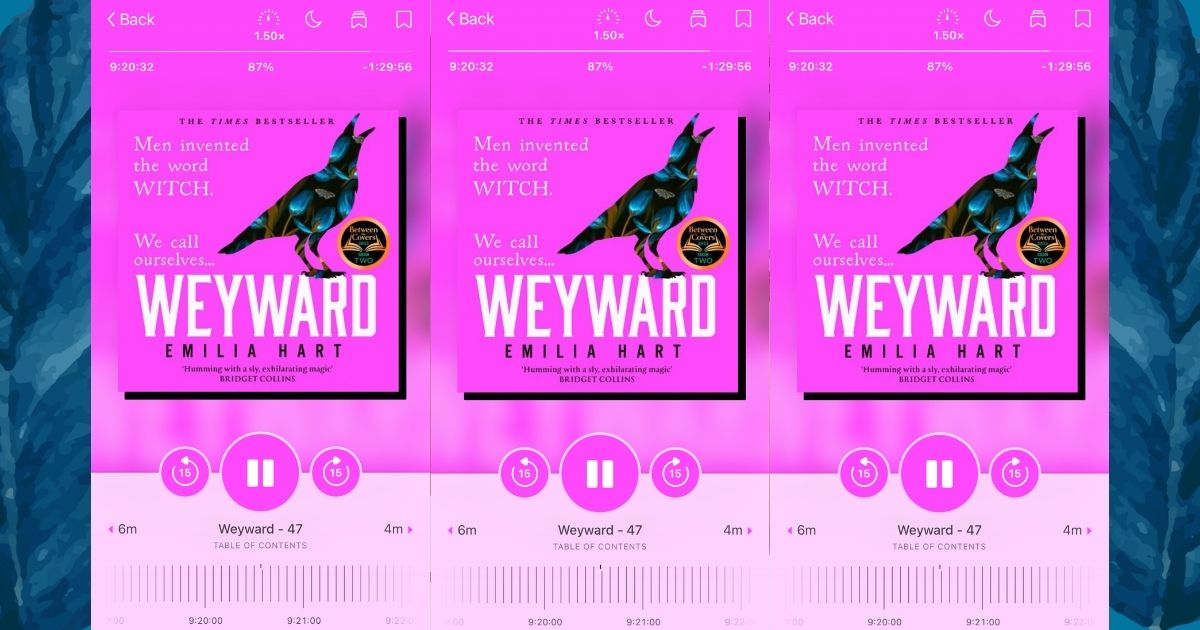
The audiobook has three narrators: Aysha Kala, Helen Keeley, and Nell Barlow, and each does such a distinctive job that the characters were easy to follow.
The structural bones of the story (three women, across time, facing versions of the same oppression) are solid enough. The plotting is competent. The timelines converge as you expect. The twists are visible from some distance, which isn’t always a problem, but here the predictability compounds with the familiarity of the central premise to make the whole feel like territory that has been well and truly covered. Towards the end of the novel, I just wanted to hurry along.
And that’s the core of it. This story: women failed by men, again and again, century after century, finding quiet power in their connection to the natural world, has been told before, and told well. Circe did it. The Mercies did it. The Good People did it, with considerably more dread and ambiguity. Weyward is handsomely executed, but it doesn’t bring anything new to the conversation, and I found myself wanting to shake the characters rather than weep for them. The naivety felt imposed by plot necessity rather than character truth. These women are written as intelligent and perceptive, which made it harder, not easier, to watch them be blindsided again and again by men who were barely trying to hide what they were.
Three stars is a complicated rating. The writing deserves more. The story, in its familiarity, deserves less. Three feels about right.
What I liked / what I didn’t
What I liked
Hart’s prose is the best thing in the book: sensory, controlled, genuinely literary. The multicast audiobook narration is exceptional; Aysha Kala, Helen Keeley, and Nell Barlow each make their character entirely their own. The structure across the three timelines is clean and well-managed, and the Cumbrian setting is rendered with real atmosphere.
What I didn’t
The central premise: men failing women, across centuries, and there’s witchcraft. It feels familiar to the point of feeling well-worn. The insect imagery, which is evocative at first, becomes a repetitive tic by the end. The plot points are largely predictable, and the characters’ repeated naivety in the face of obvious threat tested my patience more than it moved me.
Final verdict
Weyward is not a bad book. It’s a well-made one. Hart writes with genuine skill, and the audiobook production is fantastic. But finishing it left me with the feeling that I’d read this story before, and that some of the books that told it first told it better. If you’re new to this corner of literary fiction, you may find it quietly devastating. If you’ve already read widely in the women-and-witchcraft space, you may find yourself a few steps ahead of it at every turn.
Borrow it from the library first. The audiobook version specifically.
| Format | Platform | Cost | Notes |
|---|---|---|---|
| Physical | Booktopia The Nile | Paid | Available in paperback and hardcover. Both ship Australia-wide. The Nile is Australian-owned. |
| Library | Your local library BorrowBox Libby | Free | Free with a library card. This is where I borrowed the audiobook, and it's my strong recommendation -- try before you buy. BorrowBox also carries digital editions. Availability varies by council. |
| eBook | Booktopia Kindle / Apple Books / Kobo | Paid | Available across all major eBook platforms. At 384 pages, it's a manageable read on screen. |
| Audiobook | Audible AU BorrowBox (library)* Libby (library)* | Paid / Free* | Not author-narrated. Performed by Aysha Kala, Helen Keeley, and Nell Barlow -- one narrator per timeline. Runs 10 hrs 51 mins. This is genuinely the best way to experience this book. Free via Libby or BorrowBox if your library carries it. |
* Free with a valid Australian library card where available through your library's Libby or BorrowBox partnership.
Weyward by Emilia Hart: A Book Review
The writing is lovely. The story has been told before. Weyward is three stars of a very specific kind; the kind where the craft outpaces the originality.
URL: https://www.goodreads.com/book/show/127280850-weyward
Author: Emilia Hart
3