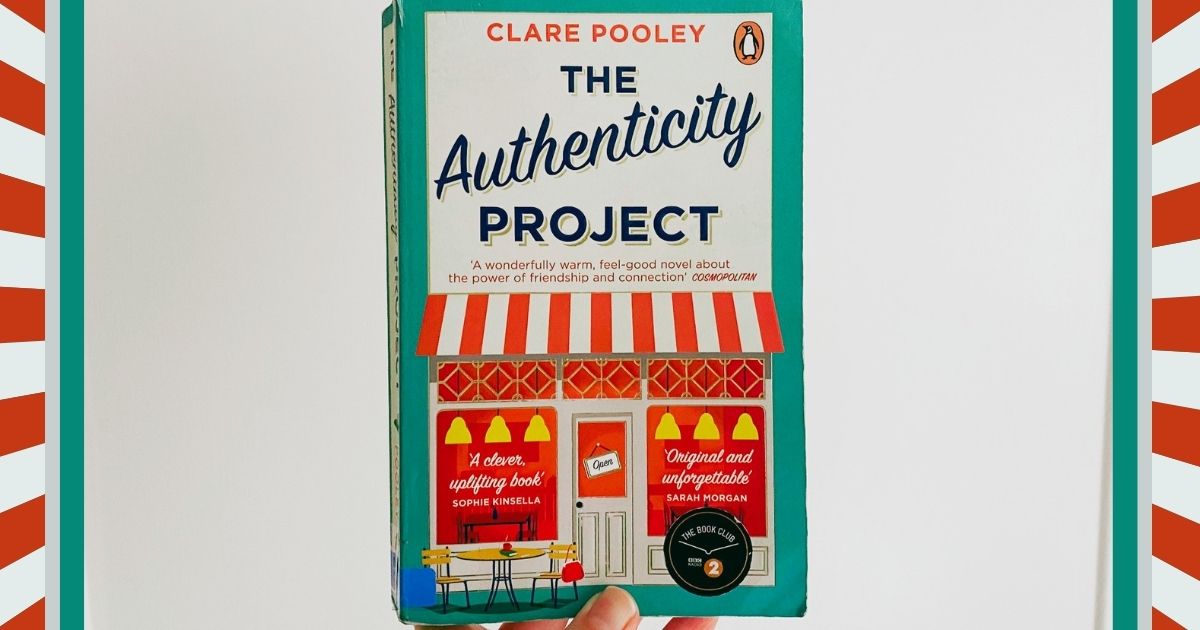
At a glance
The Authenticity Project
Clare Pooley
| Genre | Contemporary fiction |
| Format | Paperback |
| Source | Book club, local library |
| Did I finish it? | Yes, in 4 days (book club motivation required) |
| My rating | 2 / 5 |
| Read if you liked | The community warmth of Eleanor Oliphant is Completely Fine. |
| Would I recommend it? | ✕ No |
The Authenticity Project is Clare Pooley’s debut novel, and the cover is wrapped in the kind of glowing blurbs from the likes of the Daily Mail and Cosmopolitan promising warmth, community, and a good cry – ‘A positive and uplifting Story’, said Sophie Kinsella. What it delivers is a little more complicated — or rather, a little less.
Synopsis
Julian Jessop is a 79-year-old artist, lonely and largely invisible, who decides to write the truth about his life in a plain green notebook and leave it in his local London café. The café owner, Monica, finds it, adds her own confession, and passes it on. One by one, a small cast of characters discovers the notebook, contributes their own truth, and finds themselves drawn into each other’s lives in ways none of them expected.
My Review
The premise of The Authenticity Project asks a lot of the reader. You have to believe that person after person, a stranger finding a notebook in a café or a wine bar , would not only stop to read it, but would also trust it enough to add their own most private thoughts and pass it along. It is a stretch, and the book never quite earns it. The central conceit is the engine of the entire novel, and it idles rather than accelerates.
The characters are a mixed bag, and not evenly mixed. Monica is the most grounded of the ensemble. The others, particularly Hazard, fare less well. Hazard is positioned as a charming, slightly dissolute man, the sort who drinks too much and coasts on his looks, but his dialogue and interior monologue read like they were written by someone who is themselves, a Monica. He uses vocabulary and constructions that feel lifted from a different character entirely. When a book rotates perspectives, the voices need to be distinct. Too often here, they are not. It’s just more Monica: more middle-aged female.
The novel also leans heavily on Emmeline Pankhurst as a kind of shorthand for feminism, and not always accurately. Emmeline Pankhurst fought for women’s right to vote; for equality. Invoking her as a figure who would disapprove of a woman flirting with a man misreads the movement entirely, and the word “feminist” is used throughout in ways that suggest the author and I have different working definitions. I like to believe EP wouldn’t have cared if you flirted with a man. Monica, herself, reminds us that EP was married with five kids; she advocated for women to have a choice, a say, and equal rights under the law. The repeated, oft-incorrect EP references, spread across nearly 300 pages, become increasingly wearing.
There are other small irritations that compound: an eye-rolling vegan character who exists mainly as a stereotype (which, as a vegan myself, grinds my gears), dialogue that feels more comfortable than true, and a resolution that wraps everyone’s story with a sort of neat tidiness that is deeply unrealistic, if you prefer your fiction to have some grit.
Pooley is clearly a warm writer. The affection she has for her characters is evident. But warmth alone does not hold up a novel, and the structural reliance on coincidence and feel-good resolution means The Authenticity Project works better as comfort reading than as something to engage with critically.
What I liked
The premise, for all its implausibility, is at least original. The idea of a shared notebook as a vehicle for community is genuinely appealing, and Monica, as a character, is the closest the book gets to someone who feels fully realised. The pace is quick with short chapters, and I finished it in four days, though I should note that my book club provided the motivation, and I would not have found it on my own.
What I didn’t
The character voices are too homogeneous, particularly the male characters, who largely sound like the same person in different outfits.
Late 30s woman
Late 20s woman
Early 80s man
Early 30s man
Late 30s man
ALL SOUND THE SAME.
The feminism references are misapplied and overused. The vegan character is a lazy stereotype. And the emotional resolution feels engineered rather than earned.
Final Verdict
This is not a bad book. It is an earnest one, written with evident care and a genuine belief in the redemptive power of honesty and community. If you love feel-good ensemble fiction and are not particularly bothered by credibility gaps, you may find it a perfectly pleasant read.
I am not that reader. I would never have picked this up unprompted. It is giving airport table impulse purchase, and without my book club, I would have set it down very early on. Two stars, and no recommendation from me.
One small aside worth noting: in the acknowledgments, Pooley mentions that her father responds to reviews of this book. I write warily knowing that, but I’m not going to praise a book I didn’t enjoy.
WHERE CAN I READ IT?
| Format | Platform | Cost | Notes |
|---|---|---|---|
| Physical | Booktopia The Nile | Paid | Available in paperback. Both ship Australia-wide. The Nile is Australian-owned. |
| Library | Your local library BorrowBox Libby | Free | Free with a library card. BorrowBox and Libby both offer eBook and audiobook borrowing digitally. Check your local library's app partnerships -- availability varies by council. |
| eBook | Kindle / Apple Books / Kobo / Google Play | Paid | Available across all major eBook platforms. 384 pages -- a comfortable length for screen reading. |
| Audiobook | Audible Libby (library) | Paid / Free* | Narrated by Anna Cordell (not the author). Runs 10 hrs 25 mins. Free via Libby if your library has it. |
* Free with a valid Australian library card where available through your library's Libby partnership.
The Authenticity Project by Clare Pooley: A Book Review
A green notebook. A café in London. Six strangers who all, apparently, stop to read it and pour their hearts onto the page. It is giving airport table impulse purchase -- and not in a good way.
URL: https://www.goodreads.com/book/show/55789067-the-authenticity-project
Author: Clare Pooley
2